Swami Sarvapriyananda Illuminates IIT Bhubaneswar with Profound Discourse on Mind and Consciousness
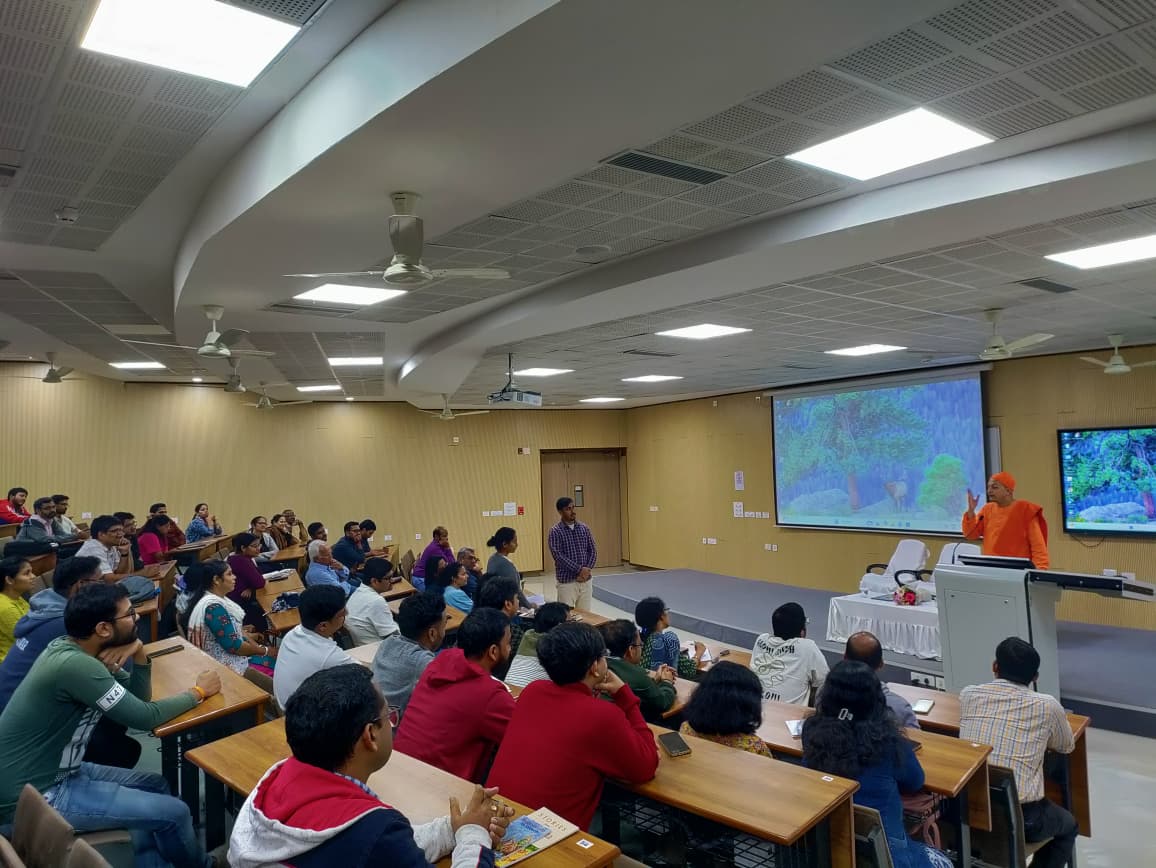
On a vibrant day at the Indian Institute of Technology (IIT) Bhubaneswar, students and faculty gathered to witness a remarkable discourse delivered by Swami Sarvapriyananda, a prominent monk of the Ramakrishna Order. The event focused on the intricate themes of mind and consciousness, drawing from both ancient wisdom and contemporary scientific perspectives.
Understanding Mind and Consciousness
Swami Sarvapriyananda began his lecture by delving into the definitions and distinctions between mind and consciousness. He emphasized that while the mind is often associated with thoughts, emotions, and perceptions, consciousness is the underlying essence that makes awareness possible.
The Swami articulated that consciousness is not merely a byproduct of brain activity but a fundamental aspect of existence itself. He quoted various philosophical texts and scientific studies, illustrating how both ancient sages and modern neuroscientists have grappled with these profound questions.
Philosophical Insights
Drawing from Vedanta, a school of Hindu philosophy, Swami Sarvapriyananda shared insights on the nature of the self (Atman) and its relationship to the universal consciousness (Brahman). He explained:
- The concept of non-duality, where the individual self is seen as one with the universal consciousness.
- The significance of self-inquiry in understanding one’s true nature.
- The role of meditation in transcending the limitations of the mind.
He encouraged the audience to explore these ideas through personal experience rather than mere intellectual understanding, suggesting that true knowledge comes from direct realization.
Scientific Perspectives
Transitioning to a more scientific viewpoint, Swami Sarvapriyananda discussed recent advancements in neuroscience that explore the nature of consciousness. He referenced studies that investigate:
- The brain’s role in generating conscious experience.
- The phenomenon of altered states of consciousness through practices like meditation.
- The implications of consciousness studies on artificial intelligence and machine learning.
By bridging the gap between spirituality and science, the Swami highlighted that both realms seek to understand the same fundamental truths about existence.
Practical Applications
In his discourse, Swami Sarvapriyananda also touched upon the practical applications of understanding mind and consciousness in daily life. He proposed several strategies for students and professionals alike:
- Mindfulness Practices: Engaging in mindfulness meditation to enhance focus and reduce stress.
- Self-Reflection: Regular self-reflection to gain clarity on personal goals and motivations.
- Emotional Intelligence: Developing emotional intelligence to improve interpersonal relationships and communication.
He asserted that these practices not only contribute to personal growth but also foster a more compassionate and understanding society.
Engagement with Students
The session concluded with an interactive question-and-answer segment, where students posed various inquiries regarding the interplay of mind, consciousness, and technology. Swami Sarvapriyananda responded with patience and depth, encouraging critical thinking and exploration of these complex topics.
Many students expressed their appreciation for the insights shared during the discourse, noting how it inspired them to delve deeper into both their academic pursuits and personal development.
Conclusion
Swami Sarvapriyananda’s visit to IIT Bhubaneswar was not just an academic event but a profound exploration of the self and consciousness. His ability to weave together ancient wisdom and modern science resonated deeply with the audience, leaving them with valuable insights and a sense of curiosity about the nature of existence.
Note: The discourse by Swami Sarvapriyananda serves as a reminder of the importance of integrating philosophical inquiry with scientific exploration, fostering a holistic understanding of mind and consciousness.