
IIT(ISM) Dhanbad Signs Joint Collaboration Agreement for Critical Mineral Appraisal
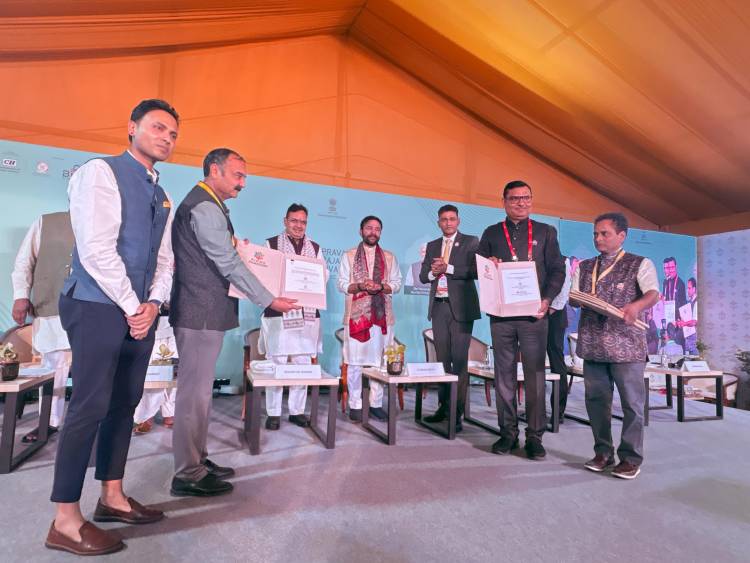
IIT(ISM) Dhanbad, in collaboration with its Technology Translation Research Park (TTRP), under the Department of Science and Technology (DST), Government of India, has recently signed a Joint Collaboration Agreement (JCA) with the Department of Mines & Geology and the Rajasthan State Mineral Exploration Trust (RSMET). This agreement aims to initiate a comprehensive multi-phase Critical Mineral Appraisal and Feasibility Study across key mineral districts of Rajasthan.
Significance of the Agreement
The JCA was exchanged in the presence of prominent dignitaries, including:
- Shri Bhajan Lal Sharma, Hon’ble Chief Minister & Minister of Mines and Petroleum, Government of Rajasthan
- Shri G. Kishan Reddy, Hon’ble Union Minister of Coal & Mines, Government of India
- Shri T. Ravikanth (IAS), Principal Secretary, Mines & Petroleum, Government of Rajasthan
This landmark agreement establishes a structured partnership between RSMET and IIT(ISM) Dhanbad, aiming to conduct a detailed assessment of critical minerals, evaluate mine waste dump sites, and explore pathways for value-added by-product recovery.
Objectives of the Collaboration
The collaboration focuses on several key objectives:
- Critical Mineral Potential Assessment: This involves evaluating mine waste dumps and associated host rocks for essential critical minerals. The focus will be on identifying high-value minerals such as lithium, cobalt, rare earth elements (REEs), nickel, and tungsten, along with potential by-products like germanium and vanadium from base-metal tailings.
- Resource Estimation and Multi-Metal Recovery: This aims to quantify the grade, volume, and techno-economic feasibility of recoverable minerals from these dumps. The study will explore sustainable beneficiation and extraction pathways, enabling the recovery of multiple metals through environmentally responsible processes.
Technological Integration
The partnership leverages advanced AI and Machine Learning (ML) analytics to generate high-impact insights. This technological integration is crucial for:
- Creating a comprehensive geo-referenced database
- Conducting high-resolution mapping
- Systematic sampling and mineralogical analysis
- Geochemical analysis and extraction feasibility studies
These efforts will help assess the presence, grade, and recoverability of strategic minerals in legacy waste dumps, positioning Rajasthan as a leader in smart and sustainable mineral exploration.
Government Support and Vision
The Government of Rajasthan has identified over 80 mine dumps and tailings across 39 districts for detailed scientific evaluation under this collaboration. This initiative aligns with national missions such as:
- Atmanirbhar Bharat
- Digital India
- India’s Critical Mineral Mission
By adopting AI and ML for next-generation mineral exploration, the project aims to enhance exploration accuracy and support India’s larger goals of mineral security and energy transition.
Statements from Key Figures
Prof. Sukumar Mishra, Director of IIT(ISM) Dhanbad and Chairman of the Hub Governing Board of TEXMiN, remarked, “This Joint Collaboration Agreement marks a transformative step in India’s critical mineral roadmap. By combining domain knowledge, advanced analytics, and sustainable exploration techniques, this initiative will unlock new opportunities for Rajasthan’s mineral sector.”
Prof. Dheeraj Kumar, Deputy Director of IIT(ISM) Dhanbad and Project Director of TEXMiN, added, “Rajasthan holds significant untapped potential in critical and strategic minerals. Through this collaboration, we aim to deploy AI/ML models, geoscientific mapping, and advanced dump-site characterization to enable informed, data-backed decision-making.”
Mr. Suraj Prakash, CEO of TEXMiN Foundation, stated, “This partnership demonstrates how industry, government, and academia can jointly build the future of mineral resource intelligence. By integrating field studies with digital geoscience, we are building a framework that will not only help recover value from legacy dumps but also position Rajasthan as a leader in next-generation mineral exploration technologies.”
Conclusion
The multi-phase programme, estimated to span 18 months, will play a crucial role in determining the presence and recoverability of key strategic minerals such as tungsten, lithium, cobalt, nickel, and rare earth elements. This initiative is expected to strengthen Rajasthan’s emerging role in supporting India’s clean-energy transition and meeting the global demand for critical minerals.
Note: This article is based on the information available as of October 2023 and aims to provide an overview of the recent collaboration between IIT(ISM) Dhanbad and the Rajasthan State Mineral Exploration Trust.


