
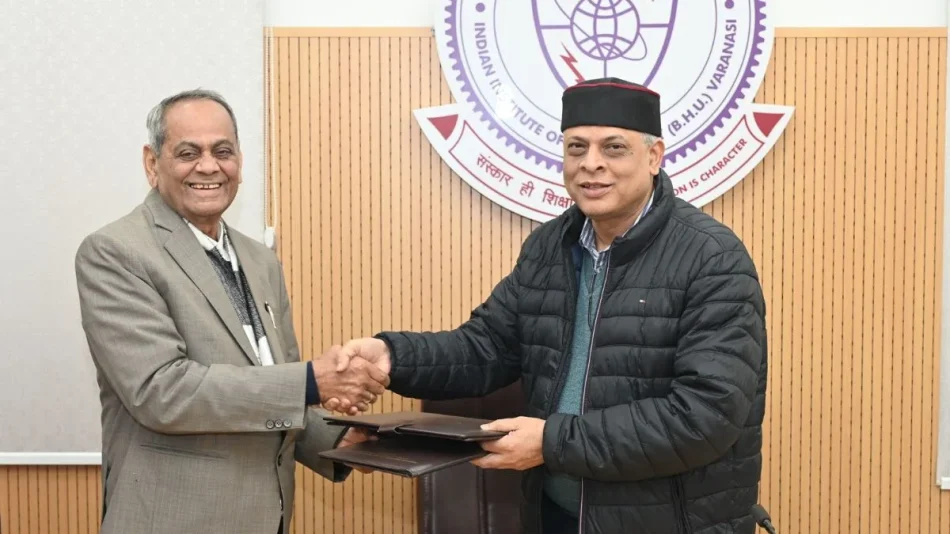
IIT BHU and FAARD sign MoU for integrating cutting-edge agricultural research
In a significant step towards agricultural innovation and rural development, the Indian Institute of Technology (IIT-BHU) and the Foundation for Advancement of Agriculture and Rural Development (FAARD Foundation) have signed a Memorandum of Understanding (MoU). This agreement aims to enhance agricultural practices and empower rural communities through advanced research and technology.
Details of the MoU
The MoU was signed on January 13, 2026, by Prof. Punjab Singh, Chairman of the FAARD Foundation, and Prof. Amit Patra, Director of IIT (BHU). The agreement will be effective for a period of five years, during which both institutions will collaborate to achieve various objectives aimed at benefiting farmers, rural youth, and Farmer Producer Organizations (FPOs).
Objectives of the Partnership
The primary goals of the MoU include:
- Integrating cutting-edge research and digital technology into agricultural practices.
- Providing on-the-ground implementation support to enhance the livelihoods of farmers.
- Developing Eastern Uttar Pradesh as a ‘lighthouse region’ for agricultural innovation.
- Combining IIT (BHU)’s technical expertise with the FAARD Foundation’s extensive rural network.
Commitment to Grassroots Solutions
During the signing ceremony, Prof. Amit Patra expressed the commitment of IIT (BHU) to transform research into effective solutions that can be implemented at the grassroots level. He emphasized the importance of technology-based empowerment for farmers, stating that this partnership is a step forward in making advanced agricultural practices accessible to those who need them most.
Prof. Punjab Singh echoed these sentiments, highlighting that the collaboration would provide farmers with better access to modern technology, knowledge, and markets. This access is expected to strengthen their livelihoods and increase their income, ultimately contributing to rural development.
Key Areas of Focus
According to Prof. Rajesh Kumar, Dean of Research & Development at IIT (BHU), the collaboration will focus on several key areas, including:
- Demonstration and dissemination of smart farming techniques.
- Development of AI and IoT-based digital twin platforms.
- Establishment of digital knowledge repositories.
- Promotion of agricultural entrepreneurship among youth.
- Integration of climate-smart and renewable energy solutions.
- Capacity building of Farmer Producer Organizations (FPOs).
- Providing practical training to students.
- Conducting research trials on farmers’ fields.
- Developing jointly funded projects.
Implications for Farmers and Rural Communities
The MoU signifies a pivotal shift in how agricultural research can be applied to real-world challenges faced by farmers. By leveraging advanced technologies and research methodologies, the partnership aims to address issues such as:
- Low productivity and inefficiencies in farming practices.
- Limited access to modern agricultural tools and techniques.
- Challenges in market access and price realization for farmers.
- Adverse effects of climate change on agricultural output.
Future Prospects
As the MoU unfolds over the next five years, it is anticipated that the collaboration between IIT (BHU) and FAARD will lead to significant advancements in agricultural practices in Eastern Uttar Pradesh. The integration of technology and research is expected to create a model that can be replicated in other regions facing similar agricultural challenges.
Furthermore, the emphasis on training and capacity building will empower the next generation of agricultural entrepreneurs, equipping them with the skills and knowledge necessary to thrive in a rapidly changing agricultural landscape.
Conclusion
The signing of the MoU between IIT (BHU) and FAARD Foundation marks a crucial step towards integrating advanced agricultural research with practical applications that can benefit rural communities. By focusing on technology, training, and sustainable practices, this partnership aims to transform the agricultural sector in Eastern Uttar Pradesh and beyond.
Note: The information provided in this article is based on the latest updates available as of January 2026.


