
Battery Electric Vehicles Cut Emissions Over Lifecycle: IIT Madras
Researchers from the Centre for Excellence in Energy and Telecommunications (CEET) at IIT Madras, along with Immersive Technology and Entrepreneurship Labs (ITEL), have conducted a pivotal study demonstrating that battery electric vehicles (BEVs) significantly reduce greenhouse gas emissions compared to petrol-powered internal combustion engine vehicles (ICEVs) over their entire lifecycle. This research is particularly relevant in the context of India’s current grid conditions.
Study Overview
The study, titled The March Towards Zero-Emission Transport: To Preserve Life on Earth by Eliminating Fossil Fuels and GHG Emissions, was led by Dr. Ashok Jhunjhunwala, a prominent figure in the IITM Research Park and IITM Incubation Cell. The research utilized a dynamic model that considers evolving scenarios of renewable energy integration and enhanced recycling rates. It examined the entire lifecycle of vehicles from raw material extraction through manufacturing, operation, and end-of-life disposal over a standardized distance of 300,000 kilometers.
Key Findings
The findings of the study reveal a stark contrast in emissions between ICEVs and BEVs:
- An ICEV emits approximately 53.84 tons of CO2 equivalent (CO2e) over 300,000 km, while a BEV emits only 33 tons under India’s current grid, which has 28% renewable energy.
- When powered by fully renewable electricity, the operational emissions of BEVs drop dramatically to just 0.03 tons.
- In terms of manufacturing emissions, ICEVs emit 8.66 tons of CO2e without renewables or recycling, compared to 9.66 tons for BEVs. However, with 100% renewable energy and complete recycling, these figures decrease to 2.89 tons for ICEVs and 2.54 tons for BEVs.
- BEVs are significantly more efficient, converting approximately 90% of electricity into traction energy, while petrol engines convert less than 25%.
Importance of the Study
Dr. Jhunjhunwala emphasized the urgency of this research, stating, “This study arrives at a moment when India can no longer afford to delay decisive action on transportation emissions. Our cities are choking, our citizens are suffering health consequences, and questions continue to be raised about whether electric vehicles are truly the answer. This analysis settles that debate with rigorous, India-specific data — BEVs are not just marginally better; they are decisively superior to petrol vehicles in reducing greenhouse gas emissions, even with our current electricity mix.”
The report highlights that the transition to electric vehicles (EVs) must coincide with a shift towards renewable electricity generation and complete recycling of vehicle subsystems, including batteries.
Context and Implications
This study is particularly relevant as Indian cities grapple with severe air quality issues. Recent analyses indicate that the largest cities in India have experienced a decade of air quality that ranges from unhealthy to hazardous, with none meeting safe Air Quality Index (AQI) standards from 2015 to November 2025. Delhi has consistently ranked as the most polluted city throughout this period.
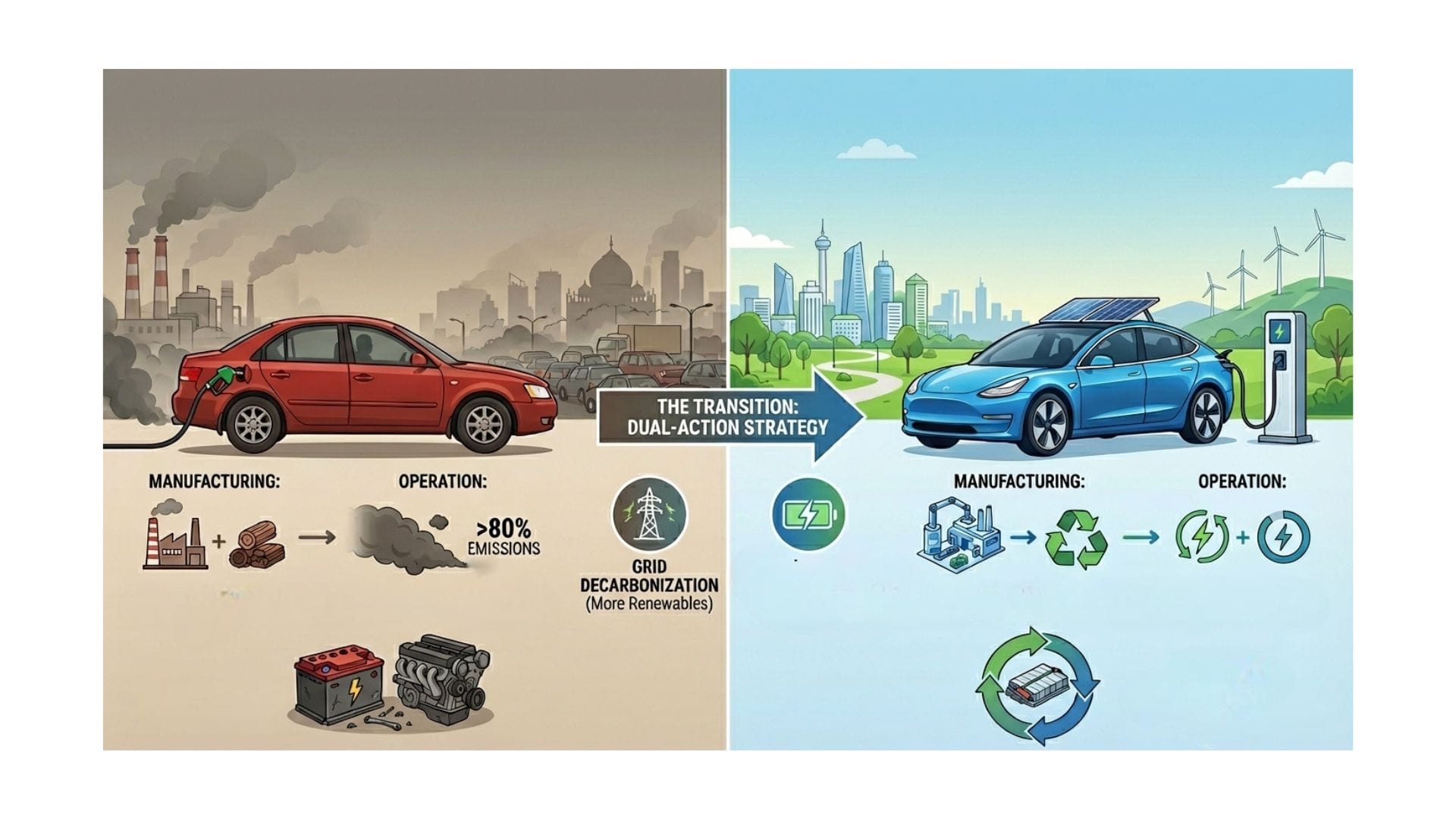
The report asserts that ICEVs are inherently limited by their carbon-intensive combustion processes, with about 80% of their lifecycle emissions occurring during operation and minimal potential for efficiency improvements. In contrast, EVs represent a significant shift towards a sustainable future. They benefit from every addition of renewable energy to the grid and advancements in battery recycling technologies.
Projections and Recommendations
The report projects that by 2040, advanced recycling technologies could recover up to 95% of key materials and reduce manufacturing emissions by 30-40%. Furthermore, the shift to EVs is expected to drive a 20-30% increase in renewable electricity generation by 2035.
The findings advocate for a dual-action strategy for Original Equipment Manufacturers (OEMs) and policymakers, emphasizing the need to prioritize grid decarbonization and invest in circular battery ecosystems. Dr. Jhunjhunwala concluded, “It is not just adopting BEVs, but also greening electricity and adopting full recycling, that will enable the earth to deal with global warming.”
Conclusion
The research conducted by IIT Madras provides compelling evidence that battery electric vehicles are a crucial component in the fight against climate change. By significantly reducing lifecycle emissions compared to traditional petrol vehicles, BEVs offer a sustainable path forward for transportation in India. As cities continue to struggle with air quality issues, the transition to electric mobility, paired with renewable energy and effective recycling practices, is not just beneficial but essential for a healthier future.
Note: The findings of this study highlight the importance of transitioning to sustainable transportation solutions to combat climate change and improve air quality in urban areas.


