
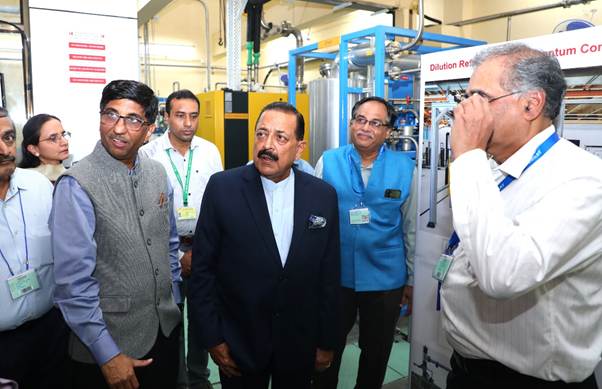
Dr Jitendra Singh Lauds Quantum Sensing Breakthroughs By IIT Bombay
New Delhi, Delhi, 24th of November 2025: Union Minister of State for Science & Technology, Dr. Jitendra Singh, reaffirmed the Government of India’s commitment to advancing frontier technologies by visiting the Quantum Research Laboratories at IIT Bombay. During this visit, he inaugurated the Institute’s new Liquid Helium Facility, marking a significant milestone in India’s growing ecosystem of quantum science, cryogenics, advanced materials, and next-generation computing.
Advancements in Quantum Sensing
During his visit to the Quantum Lab, Dr. Singh reviewed India’s first series of indigenous quantum sensing and imaging platforms, which signal a major leap in the nation’s research and development capabilities. Among the innovations presented was the QMagPI, the country’s first portable magnetometer capable of detecting ultra-low magnetic fields at the nanotesla (nT) scale. This device, developed using nitrogen vacancy (NV) centers—atomic-scale defects in diamond—enables high-precision magnetic sensing applicable in strategic sectors, defense applications, mineral exploration, and scientific instrumentation.
Quantum Diamond Microscope
Another significant development showcased was India’s first indigenous Quantum Diamond Microscope (QDM), built by IIT Bombay’s PQuest Group. This microscope, powered by NV centers in diamond, allows for nanoscale, three-dimensional magnetic field imaging. It is poised to revolutionize widefield mapping in various fields, including neuroscience, materials research, and semiconductor diagnostics. Integrated with artificial intelligence and machine learning systems, this technology promises breakthroughs in electronics, biology, geology, and next-generation chip testing, which are key pillars for India’s future technological leadership.
Healthcare Innovations
Highlighting the growing role of quantum technologies in healthcare, the Minister examined the Q-Confocal system, a homegrown confocal microscope designed to exploit the quantum properties of NV centers in nanodiamonds. This system utilizes T₁ relaxometry to enable sensitive detection of intracellular changes, particularly in Reactive Oxygen Species (ROS) levels, which are critical for early-stage cancer diagnostics. Successful experiments on U87-MG glioblastoma and keratinocyte cells demonstrate the platform’s capability to measure disease-related changes at the nanoscale.
Inauguration of the Liquid Helium Facility
Following the lab visit, Dr. Jitendra Singh inaugurated the Liquid Helium Facility, describing it as a foundational national research asset. This facility will significantly boost India’s capabilities in various fields, including cryogenic engineering, superconductivity, quantum computing, quantum sensing, photonics, healthcare technologies, and green energy devices. The Minister emphasized that liquid helium is indispensable for MRI systems, advanced materials characterization, and cryogenic electron microscopy (cryo-EM).
Cost Efficiency and Resource Conservation
The new facility is equipped with an efficient helium recovery system, which is expected to reduce the cost of cryogenic experiments to nearly one-tenth of current expenses while conserving one of the world’s rarest resources. Dr. Singh noted that as global demand for quantum computers rises, India must simultaneously strengthen its cryogenics infrastructure. He highlighted that quantum computing relies critically on dilution refrigerators, which operate at ultra-low temperatures of around 10 millikelvin (below –272°C). The inauguration of the Liquid Helium Facility lays the foundation for the future indigenous development of dilution refrigeration units, a strategic requirement for India’s long-term technological self-reliance.
Collaboration and Future Prospects
Dr. Singh acknowledged that, unlike the quantum technologies reviewed earlier, the Liquid Helium Facility has not yet received support from the Department of Science & Technology (DST). He pointed to the need for greater national collaboration to scale indigenous cryogenic capabilities. The Minister stated that both the advancements in the Quantum Lab and the new cryogenics facility reflect India’s rapidly expanding leadership in next-generation science and technology.
Vision for a Technologically Advanced India
Dr. Singh emphasized that these achievements align with Prime Minister Narendra Modi’s vision of a Viksit Bharat, where deep-tech research, strategic innovation, and indigenous development drive India’s global competitiveness. He congratulated the researchers, faculty, and students of IIT Bombay for their pioneering contributions and assured continued government encouragement for breakthroughs in quantum science, cryogenics, healthcare innovation, and national technology missions.
Note: This article summarizes the recent advancements in quantum sensing and the inauguration of the Liquid Helium Facility at IIT Bombay, reflecting India’s commitment to leading in cutting-edge technologies.


